Papi da pusher
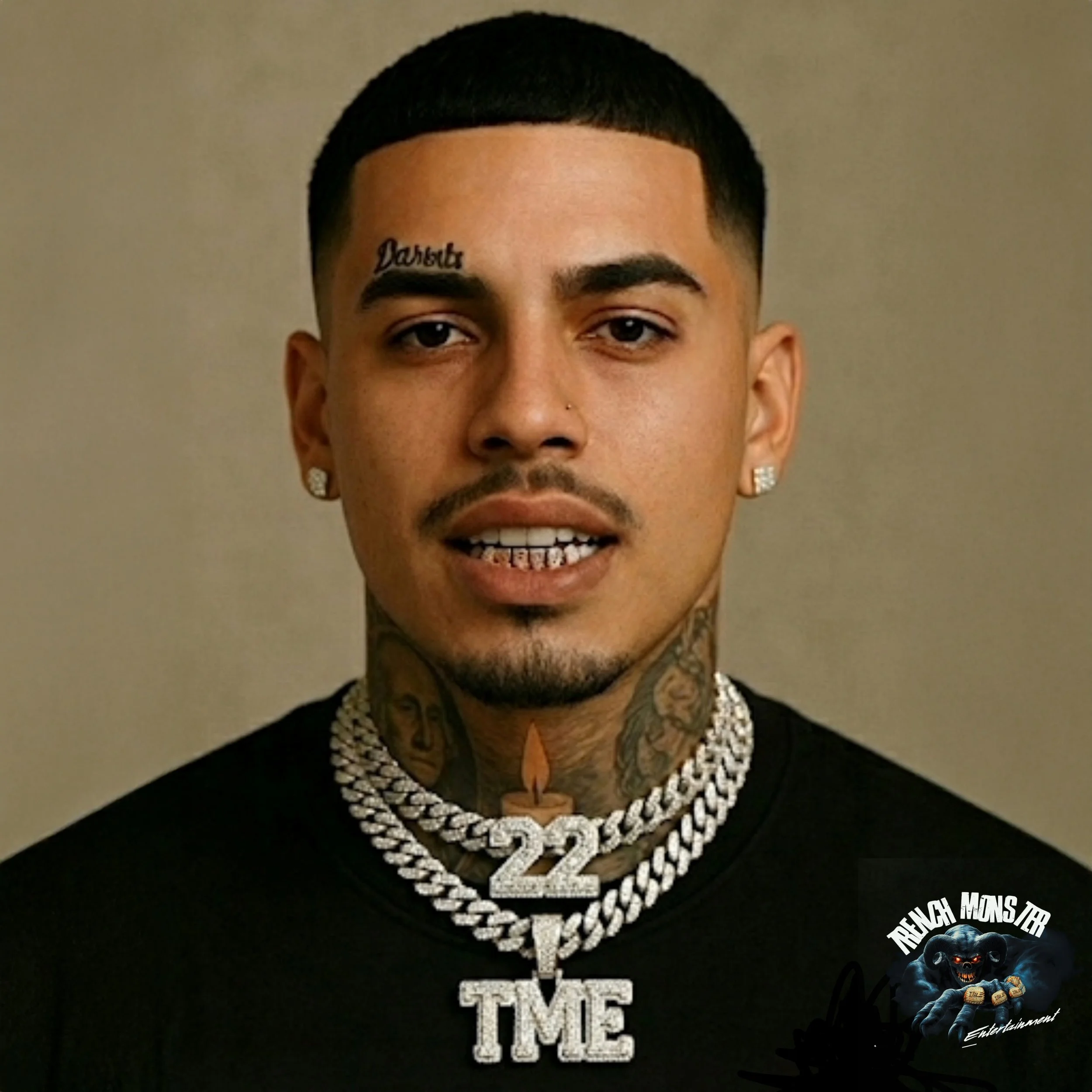
Papi Da Pusher is a 24-year-old Latino artist whose presence hits before he ever speaks. Standing 5’11”, 190 pounds, built lean and choppy, he carries himself with a calm confidence forged by survival. His look tells a story on its own—short hair with a clean taper and razor-sharp lineup, tattoos climbing from the neck down like a living archive. A candle inked at the center of his throat, symbolizing both remembrance and faith. A mouth tattoo gripping a rolled stack of money, a reminder of hunger and ambition. On the left side of his neck, a George Washington portrait lifted from the one-dollar bill, money as both power and curse. Above his left eyebrow reads “DaNorth”, permanently marking where he was shaped. A diamond nose stud, flat square diamond earrings, a slash cut through his right eyebrow—details that complete a look that’s equal parts street and star.
Blessed with pretty-boy features—brown eyes, black hair, sharp brows, thin mustache, a tight goatee, and a bottom grill flashing beneath straight white teeth—Papi Da Pusher moves effortlessly between danger and allure. Fully bilingual, his voice and words reflect two cultures, two worlds, and one truth.
Born in Inglewood, Los Angeles, Papi’s life took a sharp turn early. His mother battled addiction, and his family was torn apart—siblings lost to the foster system, stability ripped away before it ever had a chance to settle. He was sent north to Seattle, raised by his sister in the North End, a move meant to save him but one that introduced him to a different kind of chaos. The household was surrounded by gang influence and drug activity, shaped by the men his sister dated. While gangs never fully pulled him in, money did. To him, money meant control, safety, and independence—things he’d never been given.
He started hustling young. Not reckless—calculated. By the time he was 16, Papi was already a recognized factor in the North. At 17, he was riding in a Range Rover, touching real money while still legally a kid. But success came with loss. His cousin—an aspiring rapper and one of the few people he truly looked up to—was murdered. Before his cousin’s death, the two had recorded a song together. After losing him, Papi made a decision that would define his identity forever: he kept his cousin’s nickname, “Papi,” and added “Da Pusher”—a name that honored both legacy and reality.
At 20 years old, his life took another turn. Papi Da Pusher was incarcerated for manslaughter after protecting himself during an attempted robbery. The streets that raised him nearly took everything from him—but prison changed the lens. Behind the walls, stripped of motion and noise, he was forced to sit with his past, his pain, and his purpose. What could have broken him instead sharpened him.
Music became more than expression—it became testimony. Through poetry and rhythm, Papi tells the truth of a young life lived too fast, shaped by addiction, loss, money, violence, and survival. He speaks for kids raised without choices, for families fractured by circumstance, for the culture that raised him. His music stays loyal to his ethnicity, his family, his label, and the facts—never glamorized, never watered down.
Papi Da Pusher isn’t a character.
He’s a consequence.
A survivor.
And a voice carved straight from the struggle.